I was at a standing room only funeral for a Catholic priest the day Cardinal Joseph Ratzinger was elected to the Papacy. The deceased had been the pastor at my father's parish. Eight months before Father W.'s death from a sudden heart attack, he sat with us one late September afternoon at St. Mary's Hospital while my father lay dying from a stroke he had suffered just that morning. Father W. stayed with us until Dad died, a great kindness.
I never saw him again after Dad's funeral, but attending Father W.'s own funeral was a way of bearing witness to his gift of himself to our family that September afternoon. Just before the final blessing, a priest slipped a note to the bishop who was presiding at the Mass; Detroit's cardinal, of course, was in Rome for the papal election. The bishop broke into a big smile and announced, "Habemus Papam, we have a Pope! But we don't know who it is yet!" The congregation clapped and cheered, an odd occurrence at a funeral, but one that Father W. would have enjoyed.
Five years later, the arrogant behavior of the man who was elected Pope that day and the institution he leads has restarted the nightmares I suffered for many years. I have personally experienced the flabbergasting hostility and arctic chill of the Church closing ranks against children who were abused while in its care, particularly when those children return as adults to finally tell their stories. (In my case, two decades later.)
No wonder I feel that Christ's assertion, "Are not five sparrows sold for two farthings, and not one of them is forgotten before God?" doesn't apply to me.
3.31.2010

3.24.2010

3.17.2010
Home Decor?
When we were first married, we sometimes bought furniture at farm auctions in the countryside around Ann Arbor. As the years went on and we had more disposable income, we just went to furniture stores when we needed something for the house.
When we moved to Belgium, though, the exchange rate was too high for us to purchase new furniture anywhere other than Ikea, so we turned to secondhand stores--Les Petits Riens or the ubiquitous Troc--and brocantes.
To furnish our new Arvada house, I've visited furniture stores and consignment shops. I've also become addicted to perusing the furniture section of craigslist. In addition to furniture and accessories that I'd actually buy (e.g., the bars stools now sitting in our kitchen) recent offerings included the following hard-to-pass-up items:
 Eiffel Tower Lamp Base
 Driftwood Coffee Table
 Elk Antler Lamps
 Diorama Coffee Table
"Taxidermied Raccoon and 3 Blue Wing Teal ducks
in naturalized setting.
Lights at night for an elegant look."
 As my friend Georgia commented, "Just think of the countless hours of entertainment it would provide your four-footed family members."
When we moved to Belgium, though, the exchange rate was too high for us to purchase new furniture anywhere other than Ikea, so we turned to secondhand stores--Les Petits Riens or the ubiquitous Troc--and brocantes.
To furnish our new Arvada house, I've visited furniture stores and consignment shops. I've also become addicted to perusing the furniture section of craigslist. In addition to furniture and accessories that I'd actually buy (e.g., the bars stools now sitting in our kitchen) recent offerings included the following hard-to-pass-up items:
 Eiffel Tower Lamp Base
 Driftwood Coffee Table
 Elk Antler Lamps
 Diorama Coffee Table
"Taxidermied Raccoon and 3 Blue Wing Teal ducks
in naturalized setting.
Lights at night for an elegant look."
 As my friend Georgia commented, "Just think of the countless hours of entertainment it would provide your four-footed family members."
2.27.2010
Real Estate Talk Therapy
Proponents of psychotherapy claim that talking about one's bad experiences can help to alleviate some of the pain associated with them. Perhaps blogging about the experience we had purchasing our "new" house will disperse some of the black cloud hanging over it. Or, as I said to our Irish Catholic realtor, maybe we'll just hire a priest to do an exorcism.
In the 32-plus years we've been married, we've purchased four houses. The first three--one in Ohio and two in Michigan--were "For Sale by Owner." In each case, the process was cordial and smooth from purchase offer to closing. Similarly, obtaining a mortgage was painless the first three times around.
The purchase of our fourth house, which is on Zinnia Street, has been a very different and very ugly story.
THE SELLER
We made an offer, and then upped it after feedback from the seller's agent that another offer was coming in at the same time. The offer was accepted after 5 p.m. on January 27. A few hours later, we got a call from our realtor: The sellers had received a higher offer after they accepted our offer, and, since no earnest money had yet changed hands (the earnest money was to go directly to the title company, which was closed by the time of the acceptance), they were taking the higher offer.
At this point, I wanted to walk away from the deal. The sellers' questionable behavior was sending off alarms in my mind, which operated on a "Trust no one" basis long before "The X-Files." I worried that if the sellers were behaving badly early on, they could pose additional problems down the road. Jim, however, wanted to offer a slightly higher bid, with the provision that we would not continue bidding if the other prospective buyers upped their offer again.
Counseled by their agent to take our offer because we were in a better financial position than the competing buyers, the sellers accepted. In hindsight, we should have told the sellers to stuff it.
The Zinnia house, it seemed, had been a foreclosure that was purchased by a small group hoping to flip it: a recent Colorado School of Mines graduate who acted as a general contractor on renovations and a married couple who provided the financing. The husband (we'll call him RJ) in the couple is a lawyer whose practice areas, according to his firm's website, include commercial litigation and real estate.
As our president likes to say, let me be perfectly clear: I have no innate animosity against attorneys. I'm surrounded by them at family funerals and weddings. Uncle Mike is a lawyer; my brother is a lawyer; two of my first cousins are lawyers; Patrick just took the Colorado bar exam. My college roommate, Judy, who qualifies as family, is a lawyer. Our Northville neighbor, Pete, is a lawyer, as is our Arvada neighbor, Jeff.
But the behavior of the attorney behind the Zinnia house blew that line from Shakespeare's Henry VI right into my head: First thing we do, let's kill all the lawyers. RJ wasn't content to let his listing agent communicate with our agent; he frequently called and sent e-mails directly to our agent. His tone was bullying, sometimes threatening, usually couched in legalese. For example, after literally signing off on a $5,000 seller's concession to cover repairs, he declared that he hadn't understood that the $5,000 did not include the $1,500 amount put in the initial offer to cover a new furnace if the existing furnace couldn't be certified. An e-mail from our realtor summarized that conversation:
RJ . . . called me today and was adamant they were not going to pay the $1500 . . . I informed him this is a contractual obligation and there is no room for negotiation. He threatened not to show up for closing. I asked him to put that in writing and he refused. Another example: Our realtor asked RJ for a written warranty on the new roof that the house received after last summer's storm. RJ's e-mail response, which the realtor forwarded to us:
The contract only states that we need to provide "proof" of transferable warranty. Our proof is that we confirmed with our contractor that the warranty for their workmanship is transferred to the buyers for one year from the date of installation of the roof.
An attorney asking us to take his word (which hasn't been too reliable to date) that he had confirmed the roof warranty?
And so on . . .
THE BANK
We've been customers of Chase ever since it acquired Banc One (formerly National Bank of Detroit). We've had a home loan, car loans, checking and savings accounts, and a credit card with Chase. We were pre-approved for a loan that was two and a half times what we ended up requesting. We were told that it could take as little as 10 days for official approval.
Instead, the process of nailing down that money took nearly four weeks, due to an inattentive loan officer and a loan processor, who, we found out later, was having personal problems, leading her to miss work and lose/misplace documents when she was at her desk. (For example, she asked us three times for one particular document because she misplaced it the first two times we sent it to her.)
Less than 48 hours before the scheduled closing date, I got a call from another loan processor at Chase (we'll call her Carole) who was picking up "our" loan processor's work. She said nicely, "We're trying to get you ready to close in March, and I see that we're still missing [the document we'd already sent twice before]."
"Actually," I said, "if you read the purchase agreement, we're supposed to close on or before February 24, which is in two days."
"Really? Oh, I see that now . . ."
Thanks to Carole running interference for us, we did close on the 24th. However, we showed up at the title company for closing at 1 p.m. without having seen the settlement statement, ergo not knowing exactly how much cash to bring to the table. When the settlement statement did come through on the title company's fax, it was wrong: The final sale price did not reflect the $5,000 seller's concession that had gotten RJ's panties in a twist.
As a result, the settlement statement went back to underwriting at Chase, while we sat around for two hours waiting for them to get their numbers right. Every time estimate the loan officer gave us for fixing the problem his people had caused was wrong. In addition, he promised to be available by phone that afternoon, but all our calls went to his voice mail, which he rarely returned. We probably shouldn't have been surprised, since the loan officer's performance during the entire loan process was a maddening combination of a good ol' boy "Hey, I'm here for you, buddy" demeanor when you spoke with him and, for all practical purposes, apparently doing a brain wipe of anything related to our loan the moment he hung up the phone.
By the time all the drama was over, I wasn't even sure that I wanted the house anymore. I'm trying to get excited about it, but the best I can do is a mild happiness that we're getting away from the toxic black mold in the rental.
In the 32-plus years we've been married, we've purchased four houses. The first three--one in Ohio and two in Michigan--were "For Sale by Owner." In each case, the process was cordial and smooth from purchase offer to closing. Similarly, obtaining a mortgage was painless the first three times around.
The purchase of our fourth house, which is on Zinnia Street, has been a very different and very ugly story.
THE SELLER
We made an offer, and then upped it after feedback from the seller's agent that another offer was coming in at the same time. The offer was accepted after 5 p.m. on January 27. A few hours later, we got a call from our realtor: The sellers had received a higher offer after they accepted our offer, and, since no earnest money had yet changed hands (the earnest money was to go directly to the title company, which was closed by the time of the acceptance), they were taking the higher offer.
At this point, I wanted to walk away from the deal. The sellers' questionable behavior was sending off alarms in my mind, which operated on a "Trust no one" basis long before "The X-Files." I worried that if the sellers were behaving badly early on, they could pose additional problems down the road. Jim, however, wanted to offer a slightly higher bid, with the provision that we would not continue bidding if the other prospective buyers upped their offer again.
Counseled by their agent to take our offer because we were in a better financial position than the competing buyers, the sellers accepted. In hindsight, we should have told the sellers to stuff it.
The Zinnia house, it seemed, had been a foreclosure that was purchased by a small group hoping to flip it: a recent Colorado School of Mines graduate who acted as a general contractor on renovations and a married couple who provided the financing. The husband (we'll call him RJ) in the couple is a lawyer whose practice areas, according to his firm's website, include commercial litigation and real estate.
As our president likes to say, let me be perfectly clear: I have no innate animosity against attorneys. I'm surrounded by them at family funerals and weddings. Uncle Mike is a lawyer; my brother is a lawyer; two of my first cousins are lawyers; Patrick just took the Colorado bar exam. My college roommate, Judy, who qualifies as family, is a lawyer. Our Northville neighbor, Pete, is a lawyer, as is our Arvada neighbor, Jeff.
But the behavior of the attorney behind the Zinnia house blew that line from Shakespeare's Henry VI right into my head: First thing we do, let's kill all the lawyers. RJ wasn't content to let his listing agent communicate with our agent; he frequently called and sent e-mails directly to our agent. His tone was bullying, sometimes threatening, usually couched in legalese. For example, after literally signing off on a $5,000 seller's concession to cover repairs, he declared that he hadn't understood that the $5,000 did not include the $1,500 amount put in the initial offer to cover a new furnace if the existing furnace couldn't be certified. An e-mail from our realtor summarized that conversation:
RJ . . . called me today and was adamant they were not going to pay the $1500 . . . I informed him this is a contractual obligation and there is no room for negotiation. He threatened not to show up for closing. I asked him to put that in writing and he refused. Another example: Our realtor asked RJ for a written warranty on the new roof that the house received after last summer's storm. RJ's e-mail response, which the realtor forwarded to us:
The contract only states that we need to provide "proof" of transferable warranty. Our proof is that we confirmed with our contractor that the warranty for their workmanship is transferred to the buyers for one year from the date of installation of the roof.
An attorney asking us to take his word (which hasn't been too reliable to date) that he had confirmed the roof warranty?
And so on . . .
THE BANK
We've been customers of Chase ever since it acquired Banc One (formerly National Bank of Detroit). We've had a home loan, car loans, checking and savings accounts, and a credit card with Chase. We were pre-approved for a loan that was two and a half times what we ended up requesting. We were told that it could take as little as 10 days for official approval.
Instead, the process of nailing down that money took nearly four weeks, due to an inattentive loan officer and a loan processor, who, we found out later, was having personal problems, leading her to miss work and lose/misplace documents when she was at her desk. (For example, she asked us three times for one particular document because she misplaced it the first two times we sent it to her.)
Less than 48 hours before the scheduled closing date, I got a call from another loan processor at Chase (we'll call her Carole) who was picking up "our" loan processor's work. She said nicely, "We're trying to get you ready to close in March, and I see that we're still missing [the document we'd already sent twice before]."
"Actually," I said, "if you read the purchase agreement, we're supposed to close on or before February 24, which is in two days."
"Really? Oh, I see that now . . ."
Thanks to Carole running interference for us, we did close on the 24th. However, we showed up at the title company for closing at 1 p.m. without having seen the settlement statement, ergo not knowing exactly how much cash to bring to the table. When the settlement statement did come through on the title company's fax, it was wrong: The final sale price did not reflect the $5,000 seller's concession that had gotten RJ's panties in a twist.
As a result, the settlement statement went back to underwriting at Chase, while we sat around for two hours waiting for them to get their numbers right. Every time estimate the loan officer gave us for fixing the problem his people had caused was wrong. In addition, he promised to be available by phone that afternoon, but all our calls went to his voice mail, which he rarely returned. We probably shouldn't have been surprised, since the loan officer's performance during the entire loan process was a maddening combination of a good ol' boy "Hey, I'm here for you, buddy" demeanor when you spoke with him and, for all practical purposes, apparently doing a brain wipe of anything related to our loan the moment he hung up the phone.
By the time all the drama was over, I wasn't even sure that I wanted the house anymore. I'm trying to get excited about it, but the best I can do is a mild happiness that we're getting away from the toxic black mold in the rental.
2.25.2010
Rooms with a View
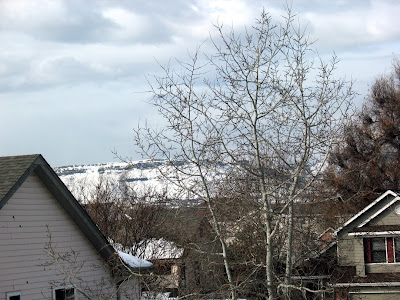
Our new house didn't rate a "Mtn. View" in its real estate listing. So, while they're not the breathtaking views of some foothills homes, we're still thrilled to be able to look out the west-facing second story windows and see a small slice of the Rockies.



2.23.2010
Think your living room is a mess?
 Above: My life, reduced to TROUT boxes.
Below: The biggest of the holes in the living room ceiling,
home to a large (and growing) population of toxic black mold.

2.19.2010
Packing. Again.
December 2006: Pack for move from Michigan to Belgium.
March 2008: Pack for move from Belgium to Colorado.
February 2010: Pack for move from 66th Place to Zinnia Street.
Lessons learned:
March 2008: Pack for move from Belgium to Colorado.
February 2010: Pack for move from 66th Place to Zinnia Street.
Lessons learned:
- No matter how much you think you've given away, thrown away, or sold prior to each move, Madonna's hit "Material Girl" keeps playing in your head as you pack. Box. After box. After box.
- Preparing to move 2.1 miles is nearly as exhausting as preparing to move across the Atlantic Ocean.
Subscribe to:
Posts (Atom)